StEP is an advanced spaceflight technology that is purely electronic—producing thrust using only solar power, without consuming any form of fuel or propellant.
'Old-school' space propulsion engines produce thrust by consuming propellant stored in tanks. Eventually, they empty those fuel tanks.
Even hybrid-electric technologies like ion or plasma engines rely on propellant. When it runs out, the mission ends—regardless of whether objectives have been achieved.
This fundamental limitation constrains every aspect of spacecraft design, mission planning, and operational capability.
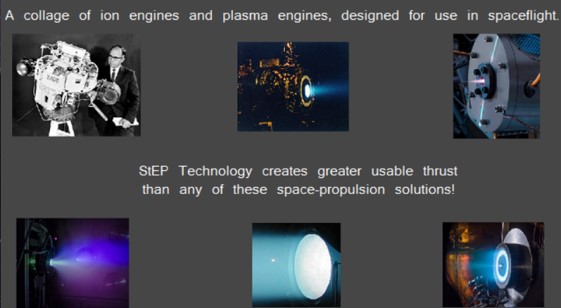
Various ion and plasma engines—all require propellant to function
StEP thrusters are not hybrid-electric engines. They require no fuel tanks and do not use ion or plasma technology to generate thrust.
StEP gets electric power from photovoltaic arrays. Wherever spacecraft travel, they can use power from the nearest star.
Thrust is generated electronically, enabling continuous operation as long as there is access to electric power.
Without fuel constraints, StEP-equipped spacecraft can accelerate, decelerate, and change trajectory indefinitely.
Lower spacecraft mass means faster acceleration and deceleration, dramatically reducing transit times.
Continuous thrust capability enables direct trajectories rather than fuel-conserving Hohmann transfers.
Eliminating fuel system mass reduces launch costs. Reusable vehicles multiply the savings.
VSL prototypes have passed several proof-of-concept tests, demonstrating the viability of propellant-free thrust generation.
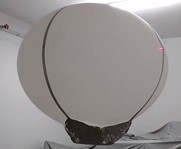
The first StEP prototype that passed all of its proof-of-concept tests was code-named '003'. To test it in mid-air neutral buoyancy conditions, we sealed it inside a helium balloon gondola and flew it around our lab.
Watch 003 in flight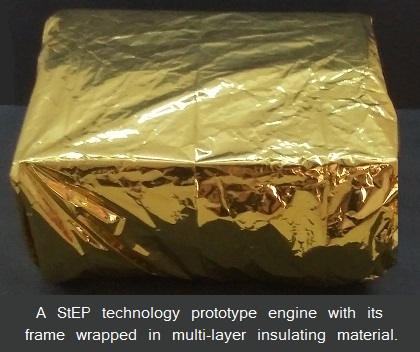
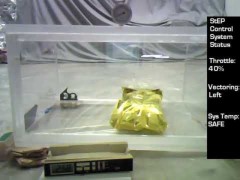
After our successes with 003, we developed thruster '003a'—using the same electronic technology but smaller, lighter, and more tightly engineered than its predecessor.
To validate performance under space-like conditions, we operated 003a inside a vacuum chamber with live telemetry monitoring throttle, vectoring, and system temperature.
Watch vacuum chamber testStEP technology enables missions that are impossible with propellant-dependent systems.
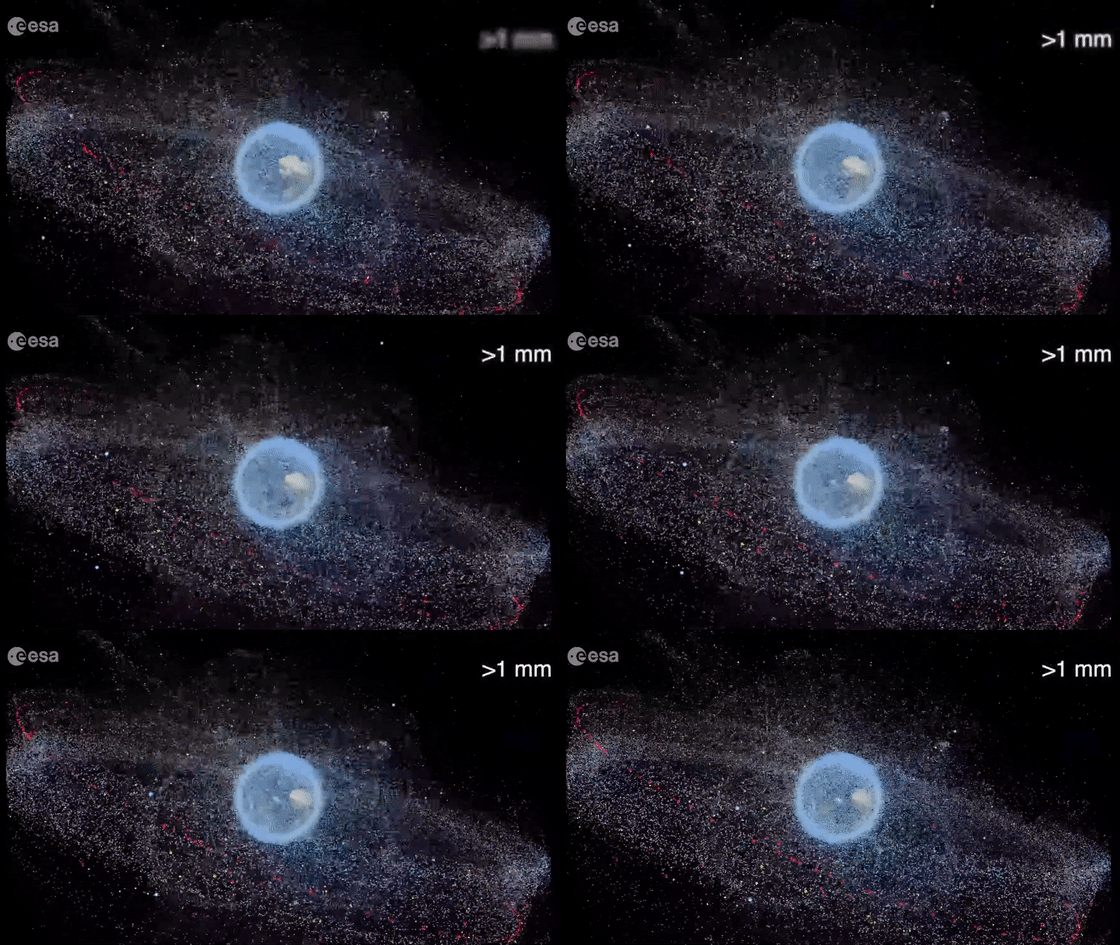
VSL Space Drones with StEP thrusters will perform multiple missions to Reduce, Reuse, and Recycle dangerous orbital debris.
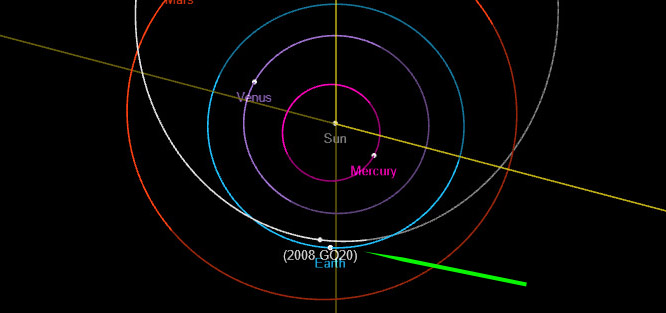
Intercept and deflect potentially dangerous Earth-crossing objects with the unlimited maneuvering capability of StEP propulsion.
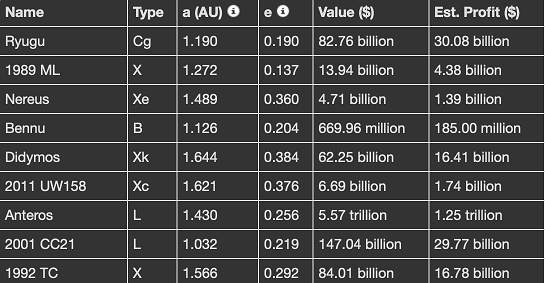
Survey, mine, and return valuable materials from near-Earth asteroids—enabled by spacecraft that can make the round trip.
Contact us to learn more about service presale discounts, partnership opportunities, investment, or technical collaboration.
Get in Touch